OEM & ODM Guides
Three Things Your Customer Judges a Water Flosser On — and None of Them Is on the Spec Sheet
A spec sheet answers seven questions. A customer asks three. The gap between them is where products fail at retail.
“How should I choose a water flosser?”
Ask that question and most spec sheets reply with seven numbers: pressure, tank volume, modes, nozzle count, battery, charge time, weight.
Ask the person who actually uses one and the answer is three sentences. Did it clean properly. Was it easy to use. Did it stay clean.
Those two lists barely overlap. That gap is where products fail at retail.
Cleaning is not a pressure number
The spec sheet answers one question: how much force. The user is asking a different one: did anything come out from between the teeth.
The two are related but not the same. A strong stream aimed at the wrong angle cleans nothing. A gentler stream placed correctly does. This is why a wider adjustable range matters more than a higher maximum — the user is not looking for the strongest setting, they are looking for the setting that does not hurt.
There is a second number worth knowing, and it surprises most buyers: at the highest setting, a 320 ml tank lasts about one minute twenty-eight seconds. Tank size decides how long a session can run, not how strong the product is.
What to check: ask which end of the pressure range your customer will actually live at. If the honest answer is the lowest few settings, the top of the range is marketing, not function.
Easy to use is mostly about refilling
Almost every complaint about difficulty traces back to a physical action, and the most common one is refilling.
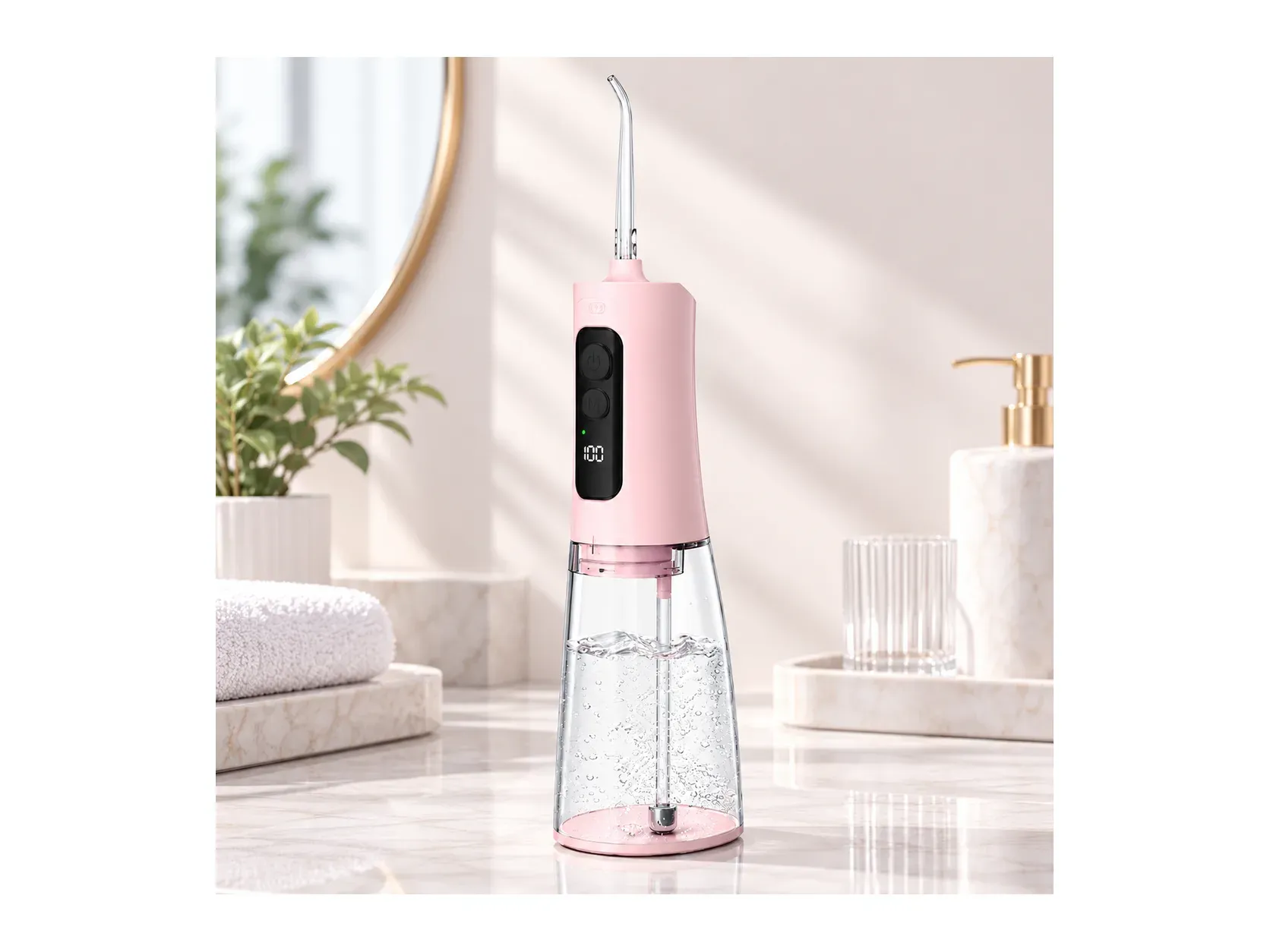
A 320 ml tank supports a full routine without a second fill. A 200 ml tank does not, unless the routine is short. Neither is better; they answer different routines. The useful detail is where the water goes in — a side inlet lets someone fill the unit without taking it apart, and a top inlet usually does not.
Mode count sits in the same place. Two modes with a continuous range, and three modes on a compact body, are both reasonable. What is not reasonable is three modes that skip the middle setting, which is exactly where most users sit.
What to check: fill one yourself, at the setting you expect the customer to use. If a normal session needs a second fill, your listing copy should not promise a full routine.
Staying clean is not on the spec sheet at all
This is the one nobody prints, and the one that produces complaints a year later rather than a week later.
Three places collect residue: the tank seam, the nozzle base, and the joint where the nozzle meets the handle. None of them appear in any specification, and all three are decided at the design stage.
What to check: ask for the cleaning instruction in writing, then test whether it can be done with the unit assembled. Any instruction that requires disassembly will not be followed.
Where the spec sheet does help
None of this means specifications are useless. They are the only honest way to compare two suppliers. They are simply not the way a customer decides.
The practical split: use the spec sheet to choose between candidates, and use the three questions to check whether the candidate you chose will survive its first month in a real bathroom.
What to check: build listing copy in two halves — numbers for the buyer, and those three answers for the end user. Most listings only do the first half, which is why they read like catalogues.
The gap is the opportunity
A competitor can copy your numbers in a week. Copying an answer about refilling takes longer, because it requires knowing which routine the product was designed for.
That is the part of a product page that is genuinely hard to write, and the part a buyer remembers when the sample arrives.
So before you print the seven numbers, answer the three sentences. If the answers contradict the numbers, change the numbers.