OEM & ODM Guides
Water Flosser Nozzles: What the Four Types Actually Do (and When Four Is Not Enough)
A practical reference for private-label brands: what each nozzle type is for, how to read a nozzle specification, and the questions worth settling before packaging.
Quick answer
Water flosser nozzles are usually sold as a set of four, and the labels on the box tend to look interchangeable from one supplier to the next. In practice they are not. A standard nozzle, an orthodontic nozzle, a periodontal nozzle and a tongue nozzle are four different shapes solving four different problems, and a set that drops any of them changes which customers the product can serve.
For a brand adding a water flosser to an oral care line, the useful question is not "how many nozzles are included" but "which four, and can my packaging explain each one in a single line". A set of four that a customer cannot tell apart is worth less than a set of three they can.
This guide covers what each type is for, how to read a nozzle specification before you commit to packaging, and the details that tend to surface only after the first shipment.
1. Start with who the nozzle is for, not how many are in the box
Nozzle sets are usually counted rather than described, which makes four nozzles sound like four features. It is closer to four different customers.
Someone wearing braces needs a nozzle that can direct water around brackets without blasting the wire fixings. Someone with periodontal pockets needs a tip that reaches below the gum line at a controlled angle. Someone with a healthy mouth and tight contacts mostly needs a narrow, precise stream. Someone who wants fresher breath may care most about the tongue attachment, which is not really a cleaning nozzle at all.
That is why the count is a weak specification. A set of four aimed at orthodontic and periodontal users serves a different market from a set of four aimed at general use, even though both are described as "4 nozzles" on a page.
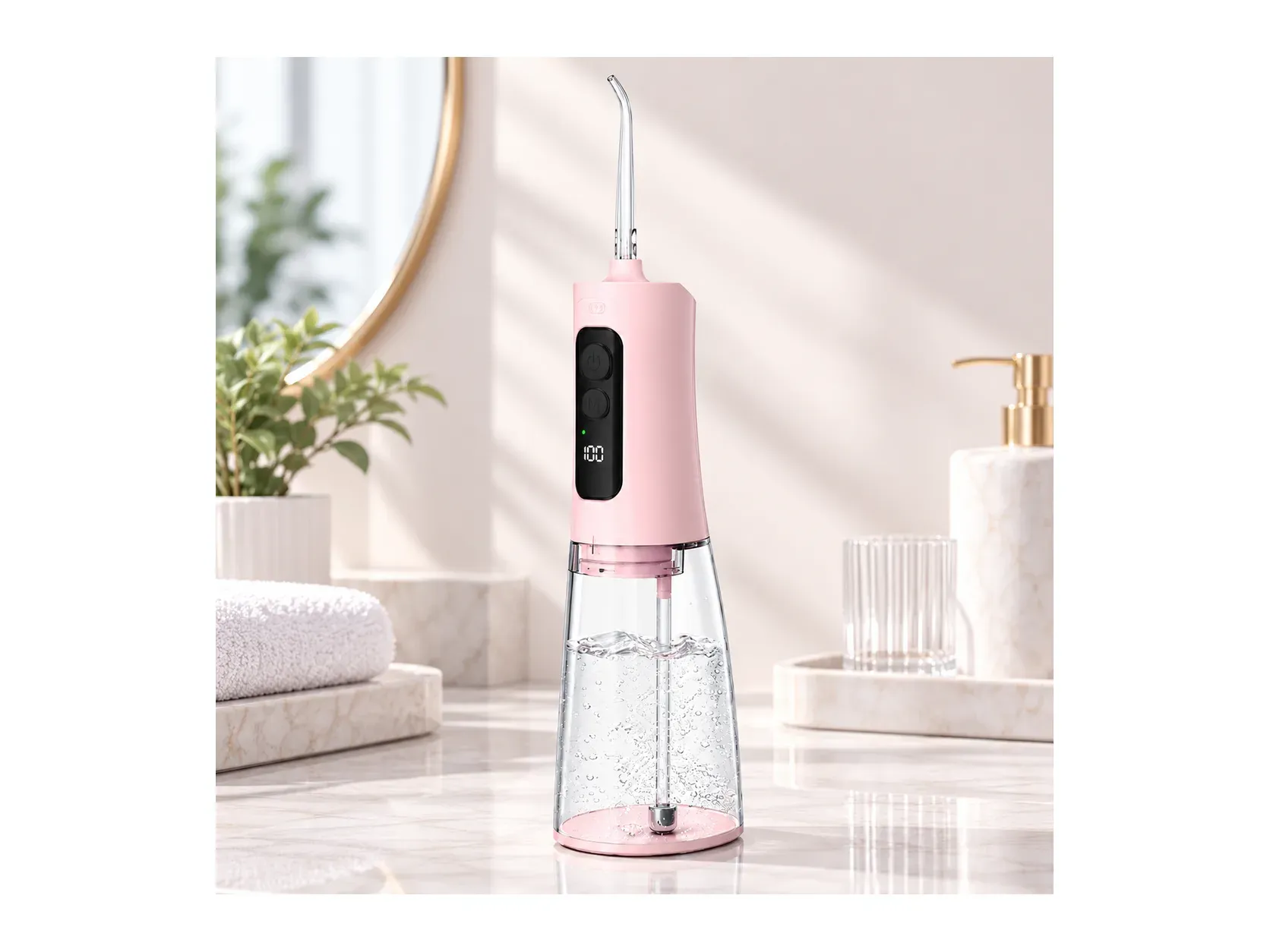
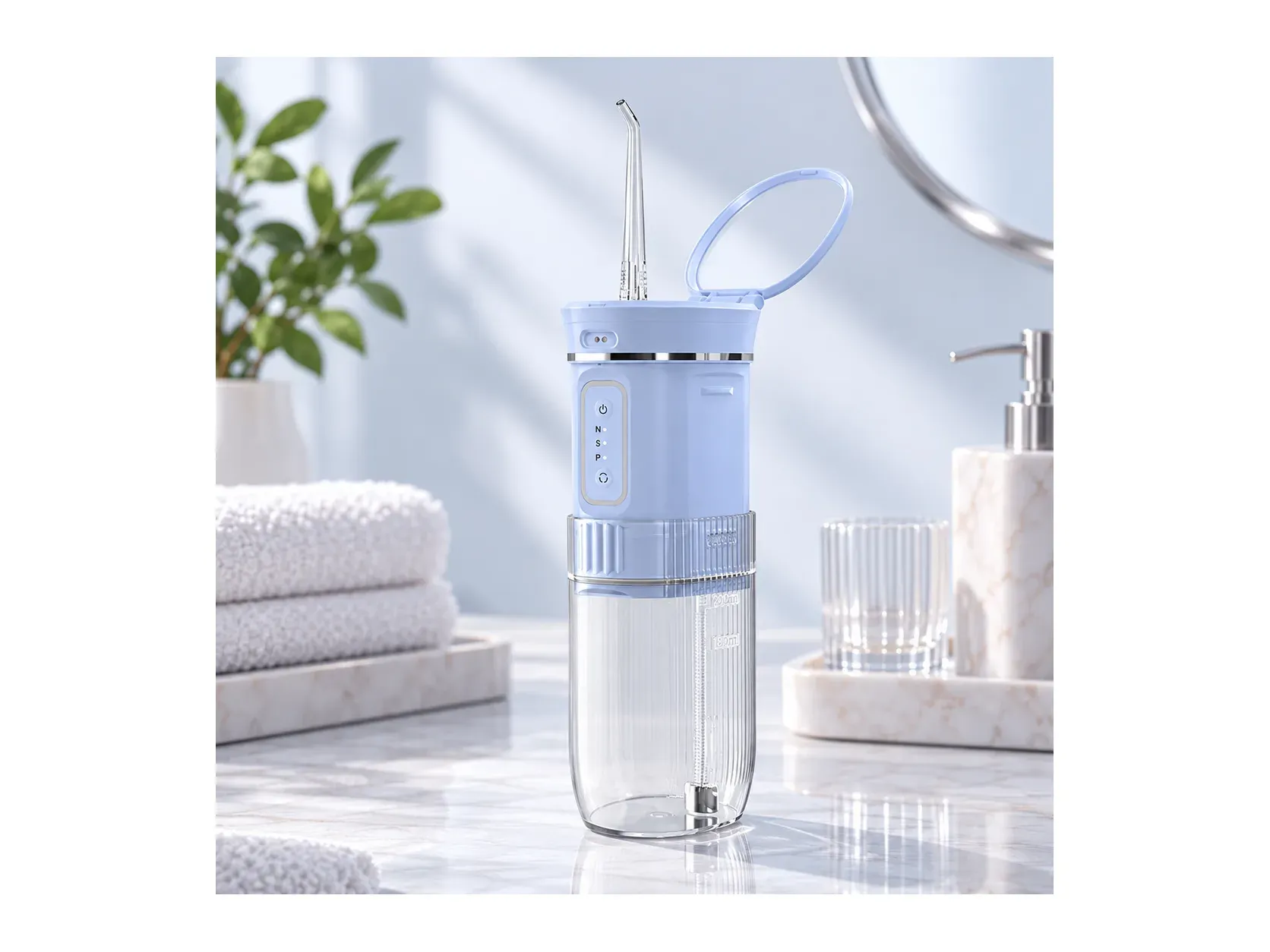
In our own range the compact model specifies its four nozzles by name: standard, orthodontic, tongue and periodontal. The countertop model is specified as four nozzle types. Those two statements look similar and are not equivalent, and the difference matters the moment you need to write a box.
2. The standard nozzle: the one most customers actually use
The standard nozzle produces a narrow, directed stream at the angle most people expect. It is the default for general cleaning between teeth and along the gum margin, and in most households it is the one that gets used while the others stay in the bag.
Because it is the default, its quality is often judged by what customers do not notice: whether the stream stays coherent at low pressure, whether the tip can reach the back molars without the user contorting, and whether it clogs when the tank runs low and the pump pulls air.
There is a mechanical reason for the last one. A pump drawing a mix of water and air produces an uneven stream, which customers read as a weak product rather than a nearly empty tank. This is also why the physical orientation of the unit matters — a tank whose pick-up sits at one corner stops drawing cleanly as soon as the unit is tilted.
None of this appears in a nozzle specification. It appears in reviews.
3. The orthodontic nozzle: the one that decides whether a niche opens
An orthodontic nozzle is shaped to direct water around brackets, bands and wires rather than straight at the tooth surface. For a customer with fixed braces, a standard nozzle tends to spray sideways off the hardware and leave food debris where it started.
This is commercially interesting because orthodontic patients are one of the few groups with an external party — their orthodontist — actively recommending water flossing. A brand that sells into that group is not creating demand from nothing; it is answering demand that a clinician already created.
It also raises the bar on the packaging. A customer with braces will look for the word orthodontic on the box before buying, and will be disappointed if the nozzle set contains four tips they cannot identify. Printing the four names is usually more valuable than printing the number four.
One caution worth noting: the fit of an orthodontic nozzle depends on the bracket type, and bracket systems vary by market. A nozzle that works well with one bracket style may be awkward with another. In our experience this is the kind of detail best confirmed with actual samples rather than with a drawing.
4. The periodontal nozzle: the one with the narrowest valid use
A periodontal nozzle has a soft, tapered tip intended to reach slightly below the gum margin, into periodontal pockets. Its purpose is cleaning in a space that a standard stream does not reach at the right angle.
It is also the nozzle with the most sensitive use case. Pressure that is comfortable on a tooth surface can be uncomfortable on gum tissue, and the correct setting varies by person and by condition. This is why the useful specification here is not the maximum pressure but the lowest usable setting — the bottom of the range is what a cautious user will actually use.
There is a reasonable argument that periodontal use should be treated as a matter for a dental professional rather than as a marketing feature. We take that view: a manufacturer can supply the attachment and describe what it is for, but the decision to use it belongs with the clinician who knows the patient's gum condition.
For packaging, that suggests restrained wording — describing the nozzle's shape and intended area, without asserting a health outcome.
5. The tongue nozzle: not a cleaning nozzle at all
The tongue attachment is the odd one in the set. It is wider and flatter, designed to be run across the surface of the tongue rather than aimed between teeth. Its job is freshness rather than interdental cleaning.
It is also the attachment most likely to be misunderstood by a first-time buyer, who may assume it is simply a spare. If the packaging does not distinguish it, a customer may never use it — and a feature that is never used does not contribute to a repeat purchase.
In a four-nozzle set, the tongue attachment is usually the cheapest component and the one most worth explaining, because the explanation costs nothing and the alternative is a customer concluding the product came with three useful parts and one mystery.
6. What a nozzle specification should actually tell you
A nozzle line that reads "4 nozzles" is a count, not a specification. The details that predict whether customers will be satisfied are usually five, and most of them are absent from a typical product page.
The first is the name of each type and what area it targets. The second is material — nozzles are commonly a polymer, and the grade affects how the tip deforms under pressure over time. The third is the connection: the way the nozzle seats into the handle decides whether it wobbles, leaks, or comes loose mid-use. The fourth is whether nozzles are interchangeable across models in the range, which affects both after-sales support and spare-part sales. The fifth is the replacement interval the manufacturer recommends.
That last one is worth asking about explicitly. Replacement nozzles are a recurring revenue line and a customer-retention signal at the same time — a customer who asks where to buy a replacement tip has already decided to keep the product.
In our experience the connection detail is the one most often skipped in a first enquiry, and the one most likely to produce complaints later, because a slightly loose nozzle reads as a defective product rather than as a tolerance issue.
Frequently asked questions
**How many nozzles should a water flosser come with?**
Four is a common set and covers general, orthodontic, periodontal and tongue use. Three is workable if you drop the tongue attachment, which is the least used. Fewer than three limits which customer groups you can address, particularly if you intend to sell to orthodontic users.
**Can customers use the same nozzle indefinitely?**
Manufacturers typically recommend replacing nozzles periodically, and the interval depends on the material and on how the unit is stored. Ask your supplier for the interval they recommend for the specific nozzle, and print it in the manual. It is also the basis of a replacement-part business.
**Are nozzles interchangeable between models?**
Not automatically. Connection geometry is model-specific, and within one manufacturer's range it may or may not be shared across platforms. This matters for spare parts and for customers who own more than one unit. It is a question worth settling in writing before you promise compatibility anywhere.
**Do all four nozzles need to be printed on the box?**
Not all, but the ones your customer will look for should be. Orthodontic users look for the word orthodontic; a set of four unnamed tips does not answer that search. If packaging space is tight, naming three and illustrating all four is a reasonable compromise.
**What material should the nozzle be?**
Nozzles are commonly a polymer, and the specific grade affects how the tip behaves under pressure and over time. Ask for the material name in writing rather than a general description, since it is one of the few nozzle details that can be verified against a document.
**Is a periodontal nozzle safe for home use?**
The attachment is designed to reach slightly below the gum margin, which is a sensitive area and one where the appropriate setting varies by person. Whether a particular user should use it is a question for their dental professional rather than for the product page.
**Can we mix nozzle configurations across markets in one order?**
That depends on how the accessory packing is assembled, and on whether the configuration affects the packaging artwork. For a first order, a single configuration across markets is usually simpler and cheaper than three variants. For a repeat order with confirmed demand per market, splitting configurations becomes worth the extra handling.
Next step
If you are choosing a nozzle configuration for a private-label water flosser, the useful information to send is short: your target market, the customer group you intend to serve first, your expected quantity and your launch timing. With those four, we can tell you which configuration makes sense and which parts of the packaging would need to change.
Our two water flossers are described on their product pages, and the contact details for a configuration conversation are on the contact page:
Contact our team with your target market, the customer group you plan to serve first, your expected quantity and your launch timing.