OEM & ODM Guides
Why We Never Recommend a Water Flosser Before Asking About Your Customer
Most brands ask which water flosser to add. We ask who will use it. Here is why the answer changes the choice more than any specification.
“Which water flosser should I add to my line?”
Most brands expect us to point at a model. We usually ask a different question first: who is going to use it?
The answer changes the recommendation more than any specification does.
The four questions we ask first
Is this for a bathroom counter, or for a bag?
What does your customer already own — nothing, or a countertop unit they want to complement?
Which matters more on your shelf: a wide pressure range, or a compact form factor?
Does the box need to state a pressure value, or a setting count?
These are not qualification questions. We are not scoring you. We ask because two devices with almost identical spec sheets can serve completely different customers — and picking wrong shows up six months later as slow sell-through, not as a complaint.
Why the tank size is the wrong place to start
A 320 ml tank sounds better than a 200 ml tank. It is not automatically better.
320 ml means one full routine without refilling. That is the right choice when the product lives on a basin edge and the habit is a five-minute session at the sink.
200 ml means less water per fill, but a body that fits in a wash bag. That is the right choice when the customer travels, or when the product is a second SKU added to a line that already has a countertop unit.
Here is the part that costs brands money: at the highest setting, a 320 ml tank lasts about 1 minute 28 seconds.
A customer who wants a long session will refill either way. Tank size decides where the product sits in a bathroom. It does not decide how strong it is.
What to check: ask your own customer when and where they will use it. If the honest answer is “mostly at home,” tank size matters. If it is “I want to take it with me,” tank size is working against you.
Why 100 levels is not 100 PSI
This is the mistake that survives longest in a comparison document, so it is worth saying plainly.
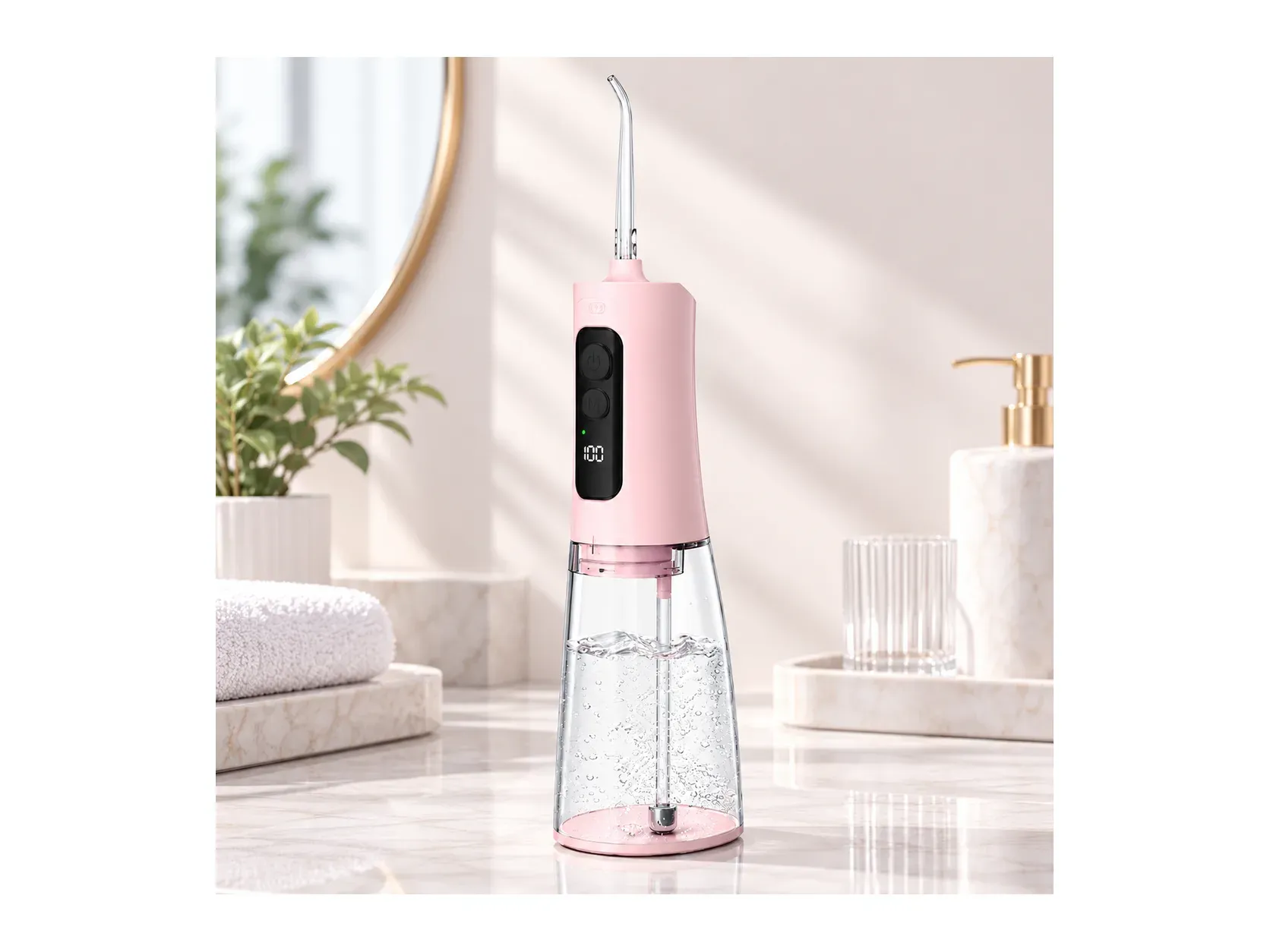
One countertop unit in our range is specified as 1–100 stepless pressure levels, with shortcuts at 20, 40, 60, 80 and 100.
One portable unit is specified as 45–60 PSI.
Those two numbers are not the same measurement.
A level count describes the interface: how many steps the control can move through. PSI describes the water: a physical pressure value.
You cannot convert one to the other without the manufacturer’s calibration. And reading “100” as stronger than “60” is a mistake that is very hard to undo once it is printed on a retail listing.
What to check: if your market compares units on a published pressure value, ask for PSI on a stated test basis — not a level count. If your market compares on how adjustable the product feels, a wide level range is the stronger story. Pick one and build the packaging around it.
What each format is actually for
The countertop format suits a brand whose story is control: a wide adjustable range, two modes, four nozzle types, a digital readout, and a product that stays on a shelf. Ours is the FTC29 adjustable flosser.
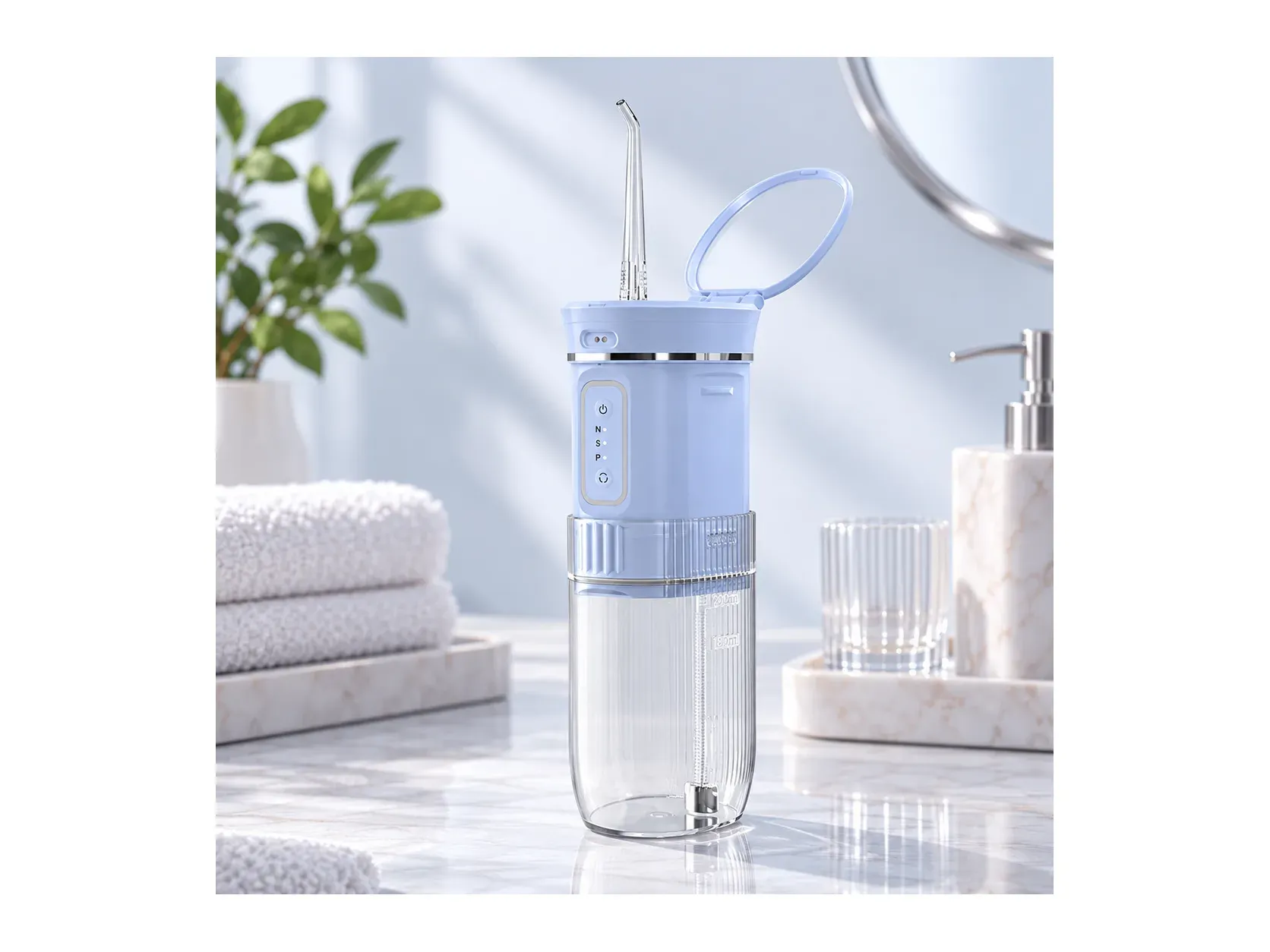
The portable format suits a brand adding a travel product or extending an existing line without competing with it: three modes, a built-in flip mirror, a pull-out tank, and a body under 140 mm tall. Ours is the FTC02 portable flosser.
One clarification worth making, because the wording on packaging often causes it: the portable unit’s visual aid is a mirror, not a camera. A customer who expects a camera and finds a mirror will not buy twice.
Neither format is the upgrade. They answer different questions.
What to check: decide which story you can actually tell on a box. A product whose advantage cannot be explained in one line on the front panel will not sell itself at retail.
Where this decision stops
Do not choose a model yet if any of these is true.
You do not know whether the product is for home or for travel. That answer decides the format before any specification does.
Your market requires a pressure figure you have not received in writing. Do not print a level count and hope it reads as pressure.
Your launch date is shorter than your sampling cycle. That is a scheduling problem, not a product problem.
None of these are reasons to stop the project. They are reasons to answer one question before choosing the product.
Before you ask which model
A good device choice does not happen because someone compared the most specifications.
It happens because someone understood the customer before comparing anything.
So before you ask us which model, tell us who will use it.